

What Is the 30/5-Minute Rule for Weddings? Everything You Need to Know
If you've ever asked a celebrant, planner, or photographer how long the "quick" family photo session will take, you've probably heard some version of the same warning: double it, then double it again. That's the 30/5-minute rule for weddings in a nutshell, and once you understand it, your entire wedding day timeline starts making a lot more sense.
If you've searched "What is the 30/5 minute rule?" while trying to piece together your own schedule, you're not alone it's one of the most common questions couples ask their planner. This guide breaks down what the rule actually means, why your wedding day feels like it's moving at two different speeds at once, and how to use it to build a timeline that doesn't fall apart by 3pm. You'll also get a sample timeline for your wedding that you can adapt for your own day, plus answers to the questions couples and vendors ask most.
What Is the 30/5-Minute Rule for Weddings?
The 30/5-minute rule for weddings highlights two simultaneous truths: tasks that normally take five minutes can stretch to thirty minutes on your wedding day, and thirty minutes of wedding bliss can feel like it passed in a mere five minutes. It is part scheduling strategy and part emotional preparation.
Some couples first hear the phrase "30/5 minute rule wedding" from their photographer, while others hear it from their celebrant. Regardless of the source, the advice is consistent. Wedding professionals lean on this rule because it solves two problems at once:
It protects your wedding schedule from the small delays that inevitably pile up when dozens of people, vendors, and moving parts are involved.
It prepares you, the couple, for how quickly the actual day disappears once the momentum starts.
Ask any experienced planner or celebrant and they'll tell you the same thing: couples who build in buffer time enjoy their day more, while couples who don't spend their day watching the clock.
In plain terms, it asks you to throw out your real-world assumptions, double your time estimates, and stop treating your wedding day like a normal Tuesday.
Recommended Read: How Long Does a Wedding Ceremony Typically Last in Australia?
Why Does Time Feel Different on Your Wedding Day?
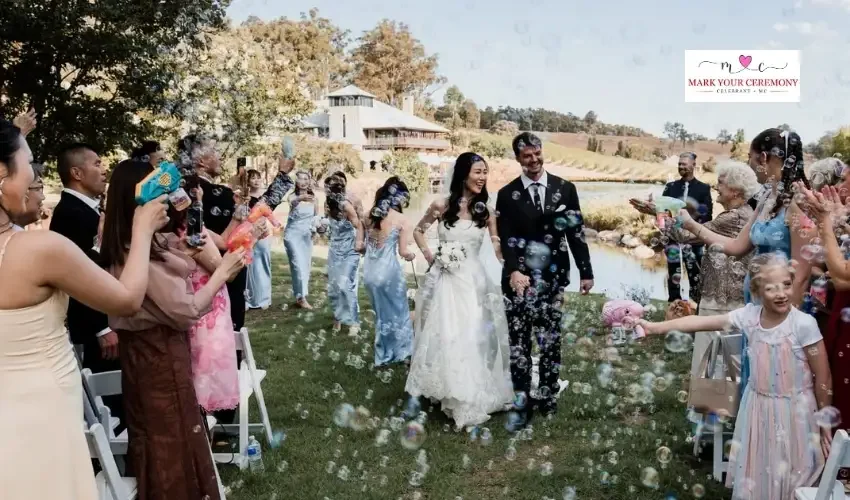
Time distorts on a wedding day because your brain is processing far more emotional and social input than usual. You're excited, guests are pulling you in different directions, and you have to make dozens of small decisions before lunch.
Here are a few reasons the clock seems to bend:
Adrenaline Compression: Excitement and adrenaline naturally compress your sense of time.
The "Quick Hello" Trap: Guests wanting your attention can easily turn a two-minute greeting into a fifteen-minute conversation.
Micro-Interruptions: Constant questions from bridesmaids, family, or vendors needing immediate answers.
The "Where's Uncle Bob?" Factor: Someone always wanders off to the bar, the restroom, or back to their hotel room right when you need the whole family together for photos. Multiply that by a few relatives, and you've lost twenty minutes before anyone notices.
Planning Tip: To prevent these distortions from ruining your day, work with an experienced professional. Mark Your Ceremony works with couples to map out exact ceremony timings from day one, ensuring the rule isn't just theory, it's built directly into your day.
Why Does the 30/5-Minute Rule Work So Well?
The 30/5-minute rule works because it accounts for how small delays multiply across a wedding day, rather than pretending each task happens in isolation. One five-minute delay in hair and makeup pushes back travel, which in turn delays photos, which ultimately delays the ceremony.
Here is where your time typically disappears:
Travel between getting-ready locations, the ceremony, and the reception venues.
Hair and makeup running behind schedule, especially with large bridal parties.
Family coordination and herding relatives for group portraits.
Photography setup, including lighting adjustments and location changes.
Last-minute wardrobe adjustments, from bustling a dress to fixing a stuck cufflink.
Here is how standard tasks transform on a wedding day when compared to an ordinary day:
This is why so many wedding professionals build their entire wedding planning timeline around the rule instead of a standard hour-by-hour wedding schedule. It's not pessimism; it's realism, and it keeps the day from unraveling. Any wedding planning timeline that skips this step tends to look great on paper and fall apart by the ceremony.
Recommended Read: Top Wedding Planning Tips for Perth Couples (Plan Smart, Stress Less)
How to Apply the 30/5-Minute Rule Throughout Your Wedding Day?
Once you understand what the 30/5-minute rule means to solve, applying it becomes a matter of walking through each block of the day and asking where delays are most likely to hide.
While Getting Ready
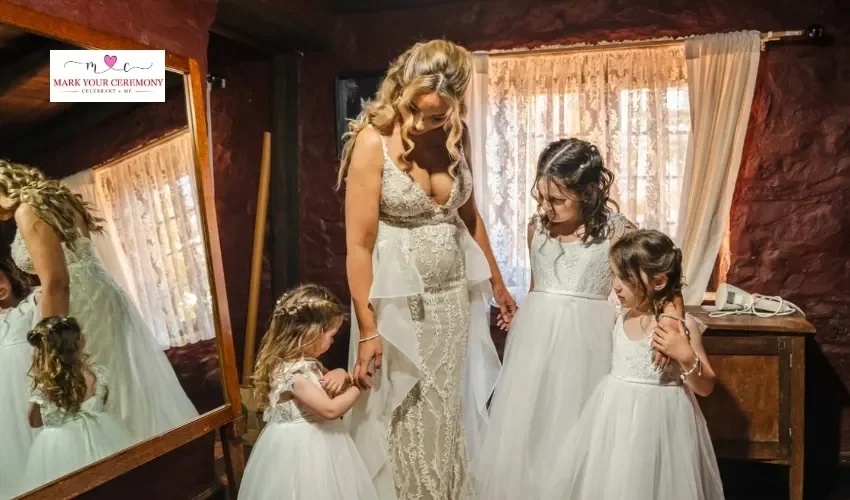
This block usually eats more time than couples expect because it's not just hair and makeup it's everything that comes with it.
Hair
Makeup
Getting dressed
Shoes
Jewelry
Bouquet
Boutonniere
Final touch-ups
Packing essentials for the day
Build extra time here first. If getting ready runs late, everything after it runs late too.
Before the Ceremony
The lead-up to the ceremony is where a tight wedding day timeline usually starts slipping, mostly because it involves the most movement.
First look
Couple portraits
Travel time between locations
Guest arrival
Vendor check-ins
Being completely ready five minutes before guests start arriving, not five minutes after
That last point matters more than it sounds. Guests notice when things feel rushed, even if they can't say why.
During the Ceremony
The ceremony itself is usually the most predictable part of the day, but it still deserves its own buffer.
Processional
Ceremony
Signing the marriage documents
Congratulations and greetings after the ceremony
During the Reception
This is where a wedding photography timeline and a reception schedule overlap the most, and where the 30/5 rule earns its keep. A good wedding photography timeline builds in movement time between each of these moments rather than stacking them back to back.
Cocktail hour
Family and group photos
Grand entrance
Dinner
Speeches
Cake cutting
First dance
Sunset portraits
Dancing
Group photos belong here, not squeezed in right after the ceremony when everyone is still finding their seats and grabbing drinks.
Sample Wedding Timeline Using the 30/5-Minute Rule
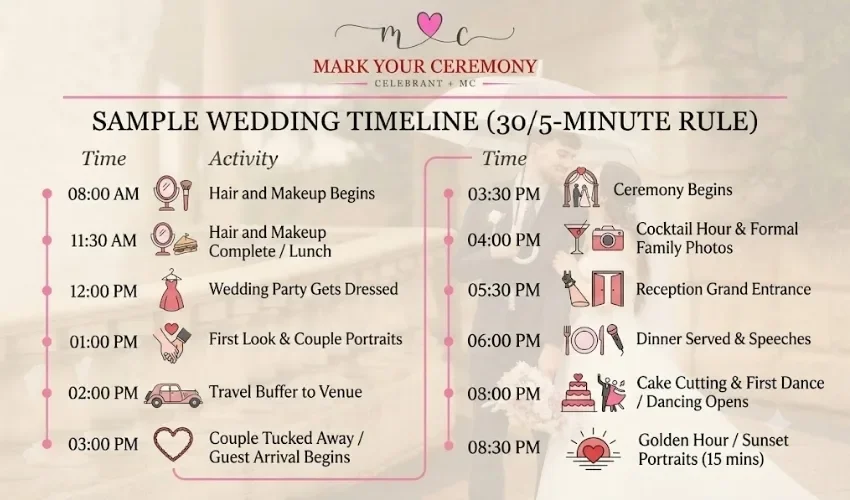
Here's a wedding timeline example built around the rule, with buffers already worked into the schedule:
Notice the intentional gaps in this example. Hair and makeup are given a wide window. Travel gets a full hour instead of the twenty minutes a navigation app might suggest. Those aren't scheduling mistakes; they are the 30/5 rule doing its job to catch delays before they catch you.
Recommended Read: MC Services for Small vs Large Weddings
How to Build a Stress-Free Wedding Timeline Using the 30/5 Rule?
This is the part of the wedding planning timeline where the rule earns its keep, turning a vague schedule into one that actually holds up.
Start with your ceremony time. Everything else gets built around it.
Work backwards from the ceremony to figure out when getting ready needs to start.
Add 30-minute buffers to major activities like hair, makeup, and travel.
Include 5-minute transition periods between smaller tasks.
Coordinate with your photographer so your wedding photography timeline matches the rest of the day.
Confirm timings with every vendor, not just the ones you talk to most.
Leave breathing room before the ceremony so you're not rushing down the aisle.
Assign a "timekeeper." Hand your wedding day timeline to someone you trust, your coordinator, maid of honor, best man, or celebrant, so they can manage the schedule while you stay present. This is exactly the kind of coordination Mark Your Ceremony helps couples plan for from the start.
Does the 30/5-Minute Rule Work for Every Wedding?
Yes, no matter what the 30/5 minute rule is applied to, it adapts to any wedding size or setting, though the buffers shift depending on the format. A backyard wedding with twenty guests needs less padding than a 200-guest affair across three venues.
Small weddings need shorter buffers but still benefit from a 5-minute cushion between key moments
Large weddings need bigger buffers, especially around family photos and guest transitions
Outdoor weddings need extra time for weather-dependent setup and guest seating
Destination weddings need buffers for travel logistics and vendors unfamiliar with the venue
Backyard weddings need time for setup changeovers between ceremony and reception
Cultural weddings with multiple ceremonies need generous buffers between each ritual
Multi-location celebrations need the most padding of all, since every transfer adds risk
No matter the format, a realistic wedding planning timeline beats an optimistic one every time.
Planning something outside the standard format backyard, destination, multi-location? Contact Mark Your ceremony can help you adapt the 30/5 rule to fit your specific setup and build a timeline that actually works for it.
The 30/5-Minute Rule vs a Traditional Wedding Timeline
Modern celebrants, planners, photographers, and venues favor the 30/5 approach because it treats delays as expected, not exceptional. A traditional wedding schedule assumes everything runs on time.
The 30/5 version assumes it won't and plans for that instead which is usually the difference between a couple who's relaxed at dinner and one who's still apologizing to guests for running late.
Final Thoughts
Your wedding day won’t go exactly according to plan. And honestly, that’s ok. The 30/5-minute rule is not intended to commit you to a schedule. It’s about creating space for you to deal with the unexpected without pressure or overwhelm. Add realistic buffer time to your wedding schedule, and instead of watching the clock, you’ll be able to enjoy the moments that matter.
Whether you're planning a small backyard ceremony or a 300-person celebration, the 30/5-minute rule helps you, your guests, and your vendors maintain a smooth flow. Less pressure. Coordination improved. More time to really enjoy the laughter, the conversations, and the moments you’ll want to remember.
Planning your wedding? Mark Your Ceremony can help you build a personalised ceremony timeline that flows naturally while reflecting your story as a couple.
Frequently Asked Questions
-
Yes. A wedding photography timeline built with 30/5 buffers accounts for travel, lighting setup, and family coordination, which prevents the golden-hour portraits from getting rushed or skipped entirely.
-
Yes, though the buffers can be shorter. Even a twenty-guest wedding benefits from padding around getting ready, photos, and the ceremony start time.
-
It works especially well for these formats, since weather, travel, and unfamiliar vendor logistics tend to create more delays than a standard indoor wedding.
-
It's a budgeting principle suggesting 80% of your wedding budget goes toward the elements guests will remember most venue, food, and photography, while the remaining 20% covers smaller details.
-
Typically, yes. Planners often build the full-day schedule, while celebrants take the lead on the ceremony-specific timing and coordinate closely with the planner on the surrounding schedule.
-
Traditionally, the groom's mother helps with guest list coordination, contributes to rehearsal dinner planning, and supports both families in blending traditions, though the role varies by family.
-
Not necessarily, but 3–5 minutes is the typical range. Anything beyond 7 minutes risks losing the room, especially later in the reception when energy starts to dip.