
Writing Your Own Wedding Vows: Step-by-Step Guide (With Examples)
You're staring at a blank page, trying to find the right words for the most important moment of your life. Sound familiar? Writing your wedding vows can feel overwhelming, emotional, and, honestly, a little terrifying.
But the truth is your vows don't need to be a masterpiece. They just need to sound like you.
This guide will walk you through everything, from what wedding vows actually are to how to write wedding vows, a template you can actually use, and common mistakes worth avoiding. Whether words come naturally to you or the thought of writing your feelings down makes you want to close your laptop and walk away, this guide is for you.
Quick Summary
What are wedding vows? In Australia, it is compulsory to make legal vows to your partner, while personal vows are optional yet unforgettable.
How to write them? Follow 5 simple steps: start with your story, share what you love, make promises, add emotion, and close strong.
How long should they be? 150–250 words (1-2 minutes).
Can you read them? Yes, a confident read is better than a nervous memory blank any day.
What to avoid? Inside jokes, oversharing, rambling, and promises you can't keep.
Need help? A Perth wedding celebrant like Mark Your Ceremony can guide you through the whole process.
What Are Wedding Vows, Exactly?
Wedding vows are the promises you make to your partner during the ceremony. They're the part where everything else fades into the background and it's just the two of you.
In Australia, there are two kinds, Legal vows and Personal vows:
Legal vows are the words required under the Marriage Act 1961–short, formal statements your wedding celebrant in Australia will guide you through.
Personal vows are the ones you write yourself. They're optional, but they're the ones that make the room go quiet.
Personal vows carry a kind of weight that nothing else in the ceremony does. When you look your partner in the eyes and speak from the heart, that moment tends to stay with people long after the day is over.
Can We Write Our Wedding Vows?
Absolutely, and many couples do. Writing your vows gives you full control over the tone (romantic, funny, heartfelt, or all three), the length, and the specific promises you're making. Your celebrant will make sure everything works alongside the legal requirements.
How to Write Your Own Wedding Vows?
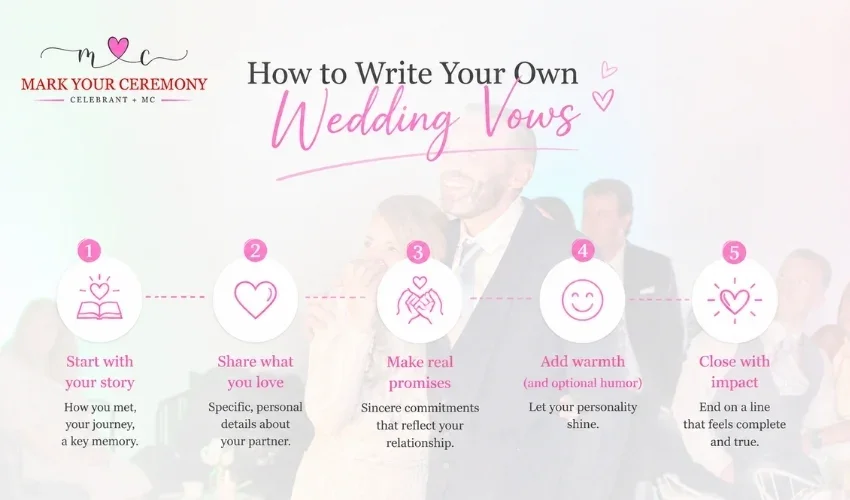
Five steps. That's it. You don't need to sit down and write a perfect first draft; you just need somewhere to start. The five steps to write your own wedding vows are:
Start with your story: How you met, your journey, a key memory.
Share what you love: Specific, personal details about your partner.
Make real promises: Sincere commitments that reflect your relationship.
Add warmth (and optional humor): Let your personality shine.
Close with impact: End on a line that feels complete and true.
Step 1: Start With Your Story
Think about how you got here. How did you meet? When did you know? What have you been through together?
You don't need to include everything, just one or two details that feel real and specific. Concrete memories land far better than sweeping statements. "I knew I loved you when you drove three hours in the rain just to be with me" hits differently than "You've always been there for me."
Prompt questions to get you started:
How did we meet, and what do I remember most about that day?
What's a moment in our relationship that changed everything?
What have we overcome together that made us stronger?
Step 2: Share What You Love About Your Partner
This is the part your partner will treasure most. Resist the urge to go big and vague. Go small and specific instead.
Not just "You're kind," but "You're the person who remembers how everyone takes their coffee." Not just "You make me laugh" but "You do impressions of our dog when you think no one's watching."
Specificity is what makes vows feel sincere. The more particular you are, the more genuine it sounds.
Step 3: Make Meaningful Promises
This is the heart of your vows. Your promises should reflect the real life you're building together, not borrowed from a movie, not generic, but genuinely yours.
Some promising starters to consider:
“I promise to always...”
“I will choose you every day, even when...”
“I vow to be your...”
“Through every [challenge], I promise to...”
Step 4: Add Emotion (and a Little Humor if It Fits)
Great vows often carry both warmth and a little lightness. If humor is a natural part of your relationship, don't be afraid to let it show; one genuinely funny line, followed by a moving promise, is often the most memorable combination of all.
Just make sure it feels natural. If you're not someone who cracks jokes regularly, don't try to become one in your vows. The goal isn't to get laughs; it's to sound like yourself.
Word of caution: Humor should feel natural, not forced. If you're not naturally a comedian, don't try to be one in your vows.
Step 5: End With a Strong Closing Line
Your closing line is what lingers after the ceremony. It should feel complete, like a landing, not a trailing off.
Examples of strong closing lines:
"Today, in front of everyone we love, I choose you, and I'll keep choosing you."
"You are my home, and I am so proud to be yours."
"I can't wait to continue building this life with you."
Recommended Read:How Celebrant Personalises Your Ceremony?
Wedding Vows vs. Wedding Speech: What's the Difference?
A lot of couples get these confused, and it's worth being clear. Wedding vows are intimate, 1–2 minute promises spoken directly to your partner during the ceremony. Wedding speeches are longer (usually 3–5 minutes), delivered at the reception, and aimed at the guests. Here's a quick comparison:
| Feature | Wedding Vows | Wedding Speech |
|---|---|---|
| Who delivers it | Each partner (to each other) | Best man, maid of honour, parents, etc. |
| When it happens | During ceremony | At reception |
| Tone | Intimate, sincere | Celebratory, humorous |
| Direction | To partner | To guests |
| Purpose | Promises | Celebration |
| Length | 1–2 min | 3–5 min |
| Required? | Legal required | Optional |
When you sit down to write, keep this in mind: vows are for your partner. Speeches are about the couple, for the guests.
The Perfect Wedding Vows Template
Stuck on where to begin? Use this template as a starting point, then make it yours.
[Partner's name],
From the moment [how you met / a specific memory], I knew there was something special about you.
You are [personal quality #1] and [personal quality #2]. You are the person who [specific thing they do that you love].
Since we've been together, you've shown me what it means to [meaningful thing they've taught you or how they've changed you].
Today, in front of [our family and friends / everyone we love], I make you these promises:
I promise to [meaningful promise #1]. I promise to [meaningful promise #2]. I will always [meaningful promise #3].
And on the days when things are hard, when life feels heavy or uncertain, I promise to [what you'll do during tough times].
You are [closing sentiment: my partner, my best friend, my home], and I am so proud to call you mine.
[Closing line, e.g., "I can't wait to keep building this life with you."]
Fill in the blanks, then read it out loud. Trim anything that doesn't quite sound like you. Let it breathe a little. The words should feel natural when you say them, not like something you memorized.
What NOT to Include in Your Wedding Vows (Avoid These Mistakes)
Knowing what not to say matters just as much as knowing what to say. A few things worth avoiding:
Inside jokes your guests won't get.
Embarrassing stories about your partner.
Unresolved grievances or "joking" jabs.
TMI (Too Much Information) moments.
Rambling without structure.
Promises you can't keep.
Copying vows directly from the internet.
For couples planning a wedding in Perth, working with a celebrant who understands local venues, traditions, and the personal nature of Western Australian ceremonies can make an enormous difference. Your vows deserve that kind of care.
Can You Read Your Wedding Vows, or Should You Memorise Them?
You can absolutely read them, and honestly, most people do.
Reading your vows removes the risk of going blank under pressure. It lets you include more detail. It means you can stay focused on the words rather than your memory. And there's something quietly moving about your partner seeing a physical card you've written for them.
Memorising, on the other hand, allows more eye contact and can feel more spontaneous. It works well if you have a strong memory and genuinely low anxiety during the day.
The best approach for most people: Write them out fully, practice reading them aloud at least five times, and bring a printed card on the day. You may not need to look at it much, but having it there removes the fear.
If public speaking makes you anxious, there is absolutely no shame in reading. A calm, present delivery from a card is far more moving than a nervous, stumbling attempt at recitation. What you're saying matters far more than how you're saying it.
How a Perth Wedding Celebrant Can Help You Write Perfect Vows:
If you're getting married in Perth and feeling stuck, a good wedding celebrant can make this whole process feel a lot less like homework. They will:
Ask you the right questions to draw out the stories and details that make your relationship yours, things you'd never think to include on your own.
Help you give it structure so it flows naturally.
Calibrate the tone so your vows sit well within the ceremony as a whole.
Give you honest feedback before the day, so nothing catches you off guard.
Make sure your personal vows sit correctly alongside the legal monitum, so your ceremony is both heartfelt and legally sound.
At Mark Your Ceremony, the process is relaxed and personal. There's no pressure and no formula. Every couple gets personalised prompts, hands-on feedback, rehearsal support, and a celebrant who's worked across all kinds of ceremony styles. The goal is simple: vows that feel completely natural and genuinely unforgettable.
Final Thoughts
Writing your own wedding vows doesn't require literary talent. It requires honesty, a willingness to be vulnerable, and a little time to sit with your thoughts.
Keep it simple. Keep it personal. Keep it real. There is no "perfect" version of your vows; there is only the version that sounds like you, spoken to the person you love. That's the one worth writing.
If you're feeling stuck or overwhelmed or just want your vows to truly stand out, reach out to Mark Your Ceremony. As an experienced Perth wedding celebrant, I'm here to help you write vows that feel completely natural, deeply meaningful, and genuinely yours.
Frequently Asked Questions About Writing Your Own Wedding Vows
-
Start with your story. Think about how you met, what makes your partner special, and what you promise for the future. Write freely first, then edit later. Keep it simple and real.
-
Most vows are 1–2 minutes long, which is around 150–250 words. This keeps it meaningful without losing attention. Short and heartfelt is always better than long and confusing.
-
Yes, you can read your vows. Many people do this to avoid stress. It's better to read confidently than forget important words during the ceremony.
-
They can be both. A mix works best. Add light humor if it fits your personality, but keep the main message heartfelt and sincere.
-
No, vows don't need to match word-for-word. But it's a good idea to agree on tone and length so one doesn't feel too short or too long compared to the other.
-
Yes, a celebrant can guide you with ideas, structure, and feedback. They help make your vows more personal and meaningful while keeping them suitable for the ceremony.
-
Personal stories, real emotions, and honest promises make vows unique. The more it sounds like you, the better it feels.
-
Start at least 2–3 weeks before your wedding. This gives you time to write, edit, and practice without rushing.
-
In Australia, legal vows are required under the Marriage Act 1961, but personal vows are optional and can be fully customised to reflect your relationship.