

Legal Documents Required for Marriage in Australia (Complete Guide)
Getting married in Australia is legally straightforward, but only if your paperwork is in order. Miss a document or submit a form too late, and your ceremony could be delayed or invalidated. This guide walks you through every legal document required for marriage in Australia, what each one does, and the mistakes that catch couples off guard.
Whether you're looking into how to get married in Australia legally, planning a quick ceremony, or an overseas national wondering about your obligations, the same legal framework applies to everyone under the Marriage Act 1961.
What Legal Documents Are Required to Get Married in Australia?
Australian marriage requirements are governed by the Marriage Act 1961, which sets the minimum legal standards for a valid ceremony. Every couple must provide proof of identity, complete a Notice of Intended Marriage, and marry in front of a registered celebrant and at least two witnesses.
Here's a quick overview of what you'll need:
Proof of identity (passport, birth certificate, or driver's licence)
Notice of Intended Marriage (NOIM) submitted at least one month before the ceremony
Divorce certificate, if either party has been previously married and divorced
Death certificate of former spouse, if either party is widowed
Certificate of No Impediment required for some overseas nationals
Complete Checklist of Marriage Documents
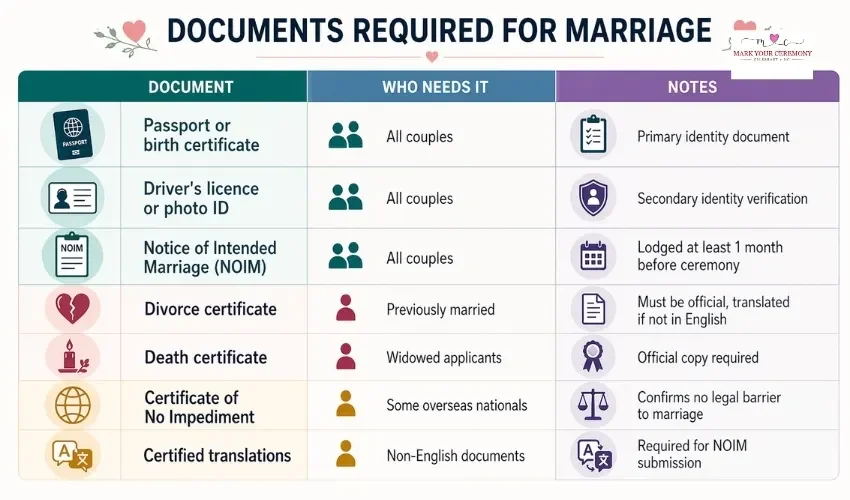
This marriage paperwork Australia checklist covers every document you'll need from the moment you book your celebrant to the day of your ceremony.
| Document | Who Needs It | Notes |
|---|---|---|
| Passport or birth certificate | All couples | Primary identity document |
| Driver's licence or photo ID | All couples | Secondary identity verification |
| Notice of Intended Marriage (NOIM) | All couples | Lodged at least 1 month before ceremony |
| Divorce certificate | Previously married | Must be official, translated if not in English |
| Death certificate | Widowed applicants | Official copy required |
| Certificate of No Impediment | Some overseas nationals | Confirms no legal barrier to marriage |
| Certified translations | Non-English documents | Required for NOIM submission |
Recommended Read: Why Hire a Professional Wedding MC?
Identity Documents (Proof of Who You Are)
Your celebrant needs to verify who you are before they can legally perform your marriage. An Australian passport is the most straightforward option. If you don't have one, a birth certificate combined with a current photo ID, such as a driver's licence, works just as well.
Foreign nationals should bring their overseas passport. If your documents aren't in English, you'll need a certified translation prepared by a NAATI-accredited translator. A photocopy won't cut it; originals or certified copies only. These are non-negotiable marriage certificate requirements in Australia.
Notice of Intended Marriage (NOIM)
The Notice of Intended Marriage form, which couples must complete, is the cornerstone of legal marriage paperwork. It notifies your celebrant of your intention to marry and must be lodged at least one calendar month before your wedding date, not 30 days, or one full calendar month.
Your celebrant holds the completed NOIM until the ceremony. After that, they send it to the Registry of Births, Deaths, and Marriages to register your marriage. You cannot legally marry in Australia without a valid NOIM on file.
In exceptional circumstances such as a terminal illness or unexpected travel, a court marriage in Australia process exists where a judge can authorise a shorter notice period. This isn't a common workaround; it requires a formal legal application.
Recommended Read: Step by Step Guide to Submit NOIM in Australia
Divorce or Death Certificates (If Applicable)
If either partner has been married before, you must prove that marriage has legally ended. A divorce certificate from the Family Court of Australia, or the equivalent overseas court, is required. A separation certificate is not enough. Only the final divorce order counts.
For widowed applicants, an official death certificate of the former spouse must be provided. If these documents are from another country, they'll need to be officially translated into English before your celebrant can accept them.
Witness Requirements
Australian law requires a minimum of two witnesses at your ceremony. They must be 18 years or older and present for the entire ceremony, not just part of it. Your witnesses sign the marriage register on the day, and their details are recorded on your certificate.
Witnesses don't need to be Australian citizens or residents. Friends, family members, or colleagues all qualify, provided they meet the age requirement.
Recommended Read: How Many Witnesses Do You Need for a Wedding in Australia?
Cost of Legal Marriage Documents in Australia
The cost of getting married legally in Australia isn't fixed; it depends on your state or territory, the celebrant you choose, and whether you need additional documents like certified translations.
Government Fees
| Fee Type | Estimated Cost |
|---|---|
| Marriage certificate (standard) | $60–$80 depending on state |
| Commemorative certificate | Varies by provider |
| NOIM form | Free (provided by your celebrant) |
| Certified translations (per document) | $80–$150 per page |
These are estimated costs only; check the official Registry of Births, Deaths, and Marriages website for the actual/updated cost.
To register your marriage in Australia, you don't pay a separate registration fee; it's included as part of the ceremony process your celebrant handles. You pay only when you apply for your official certificate from the state registry afterward.
Celebrant Fees
A registered civil celebrant charges separately for their services. Fees typically range from $500 to $1,500, depending on experience, location, and what's included. Most celebrants bundle the cost of preparing the NOIM, completing the legal paperwork, and lodging the registration with their overall fee.
Always confirm exactly what's covered before you book. Some lower-cost celebrants charge extra for travel, rehearsals, or personalised ceremony scripts.
Celebrant fees in Australia depend upon the package you choose. Explore the wedding packages provided by Mark Your Ceremony to find an option that suits your ceremony and budget.
Common Mistakes to Avoid When Preparing Marriage Documents
These are the issues that cause the most problems, and most of them are entirely avoidable.
Submitting the NOIM too late. One calendar month is a hard legal minimum. Book your celebrant early and lodge the form as soon as you've confirmed your date.
Using unofficial copies of documents. Photocopies are not accepted. Bring originals or certified copies for everything.
Forgetting translations. Any document not in English must be translated by a NAATI-accredited translator. A bilingual friend's translation won't be accepted.
Assuming separation equals divorce. Being separated does not legally end a marriage in Australia. You need the final divorce order.
Not checking overseas document requirements. If you're a foreign national, your home country may require a Certificate of No Impediment. Find out early; these can take weeks to obtain.
Leaving witness arrangements too late. Confirm your two witnesses well before the ceremony. They need to be physically present, not joining via video call.
If you are searching for same sex wedding celebrant or planning an inclusive wedding? Learn how to find an LGBTQIA+ friendly wedding celebrant in Australiawho understands and celebrates your love story.
Final Thoughts
The legal documents required for marriage in Australia are manageable; there just isn't much room for error. Get your NOIM submitted on time, bring the right identity documents, sort out divorce or death certificates if they apply, and confirm your witnesses ahead of the day.
Planning your wedding should feel exciting, not stressful. At Mark Your Ceremony, we guide you through every legal step and make sure nothing is missed. Reach out to Mark Your Ceremony today and let us help you create a smooth and meaningful ceremony.
Frequently Asked Questions
-
You need proof of identity, such as a passport or birth certificate, and a completed Notice of Intended Marriage submitted at least one month before your ceremony. If either partner has been previously married, divorce or death certificates are also required. Two witnesses must be present on the day.
-
Errors can delay your ceremony or, in serious cases, affect the validity of your marriage registration. Work through your documents carefully with your celebrant before the ceremony; they're required by law to check everything before proceeding.
-
The Notice of Intended Marriage must be submitted at least one full calendar month before your wedding date. In rare circumstances, such as serious illness or unexpected deployment, a court can grant a shorter notice period, but this requires a formal legal application.
-
Yes. There is no requirement to be an Australian citizen or permanent resident. Tourists can legally marry in Australia as long as all required documents are completed correctly and submitted on time.
-
Foreigners can marry in Australia without being a resident or citizen. Some overseas nationals may need a Certificate of No Impediment from their home country confirming they're free to marry. Any documents not in English must be translated by a NAATI-accredited translator.