
What Is the Monitum in an Australian Wedding Ceremony?
The monitum is the legal statement an Australian marriage celebrant is required to say to a couple before their vows, under Section 46 of the Marriage Act 1961. It confirms the celebrant is authorised to marry you and reminds you both of the legal nature of marriage in Australia.
If you've stumbled across the word while planning your wedding, you're probably wondering if it's some old Latin tradition or just celebrant jargon. Honestly, it's neither and both at the same time; it's a legal requirement, not something you get to pick and choose. Every couple having a civil ceremony in Australia will hear it, whether they know the word for it or not.
So let's break down why it exists, what it actually says, and where you have room to make the rest of your ceremony feel like yours.
Quick Answer:
The monitum is the legal statement an Australian marriage celebrant must say before your vows, under Section 46 of the Marriage Act 1961. It confirms the celebrant is authorised to marry you and states the legal definition of marriage in Australia.
Monitum Meaning: Where Does the Word Come From
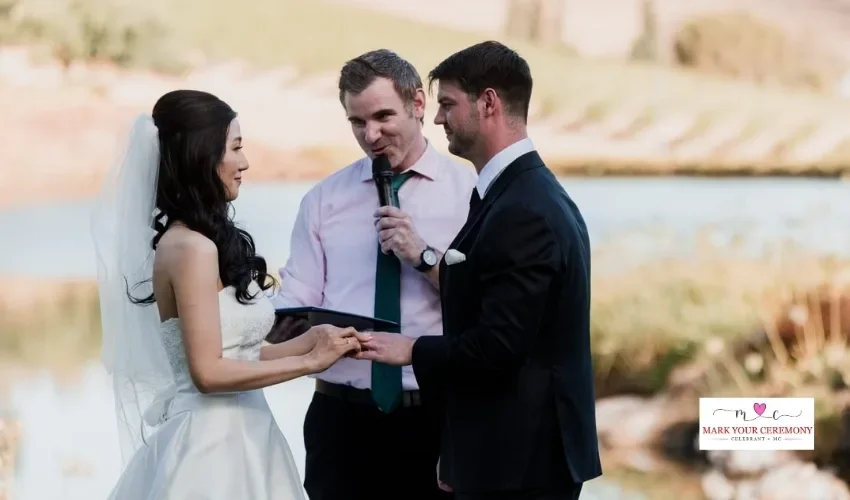
"Monitum" is Latin for "warning" or "admonition." A bit dramatic for a wedding, sure, but it fits once you know where it sits in the ceremony.
The name has stuck as insider terminology among celebrants, even though you won't find the word "monitum" written anywhere in the Marriage Act itself. It's simply the term the industry uses for that required legal passage.
It's not poetic, and it's not personal. It's fixed legal wording, and it has to be said close to word for word. Here's exactly where that requirement comes from.
Recommended Read: What Is a Wedding Celebrant in Australia?
Section 46 Marriage Act 1961: The Exact Wording
Section 46 of the Marriage Act 1961 is the exact provision that creates the monitum requirement. It applies to any authorised celebrant who isn't a religious minister and requires them to say a fixed set of words to the couple, in front of witnesses, before the marriage can be legally solemnised.
The current wording reads:
"I am duly authorised by law to solemnise marriages according to law. Before you are joined in marriage in my presence and in the presence of these witnesses, I am to remind you of the solemn and binding nature of the relationship into which you are now about to enter. Marriage, according to law in Australia, is the union of 2 people to the exclusion of all others, voluntarily entered into for life."
Three sentences. Not long, but every word carries legal weight.
Recommended Read: How Many Witnesses Do You Need for a Wedding in Australia?
Why the Monitum Exists in Every Civil Ceremony?
When you marry through a recognised religious minister, the meaning of marriage is already covered by that religion's own vows and rites. A civil celebrant has no equivalent framework, so the law fills that gap directly. That's exactly what Section 46 does.
The wording has changed twice. Before 2004, celebrants worked from a general, common-law understanding of marriage rather than a fixed legal definition. The 2004 amendment inserted a specific definition into the Act for the first time. In 2017, the Marriage Amendment (Definition and Religious Freedoms) Act updated it again to reflect marriage equality.
So the monitum isn't an old-fashioned legal habit. It's the law making sure every couple marrying outside a religious context is told, clearly and consistently, what marriage means under Australian law before they commit to it.
Recommended Read: Same-sex marriage laws in Western Australia.
Who Is Required to Say the Monitum

Whether you'll hear the monitum depends on who's marrying you:
Civil celebrants (registered marriage celebrants, this covers most independent celebrants): required to say it
Ministers of religion from a recognised denomination: not bound to Section 46's exact wording
State and Territory Officers solemnising civil marriages: required to say it
In practice, that means almost any ceremony outside a traditional church structure, backyard, vineyard, beach, or wherever, will include it.
Planning a civil ceremony in Perth? Mark Your Ceremony handles the legal side properly, monitum included, so your ceremony still feels completely your own.
Where the Monitum Fits in the Order of Service?
If you've sat through a few weddings, you've heard the monitum; you just didn't know that's what it was called.
Here's roughly where it sits:
The celebrant welcomes guests and introduces the couple
Monitum is said (this is the legal bit)
Asking for any legal objections
Vows are exchanged
Rings, declaration of marriage, signing the register
In practice, it usually takes under a minute. A celebrant who knows what they're doing will introduce it naturally, something like framing it as "before we get to the part you've both been waiting for, there are a few words I'm required by law to say," which softens the shift from welcome speech into legal territory.
Recommended Read: What a wedding celebrant does in Australia
Monitum vs Vows: What's the Actual Difference
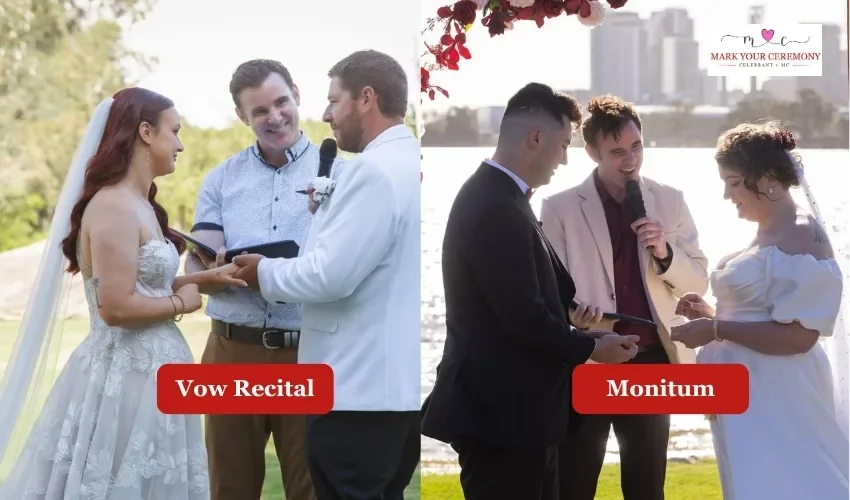
The monitum is fixed legal wording your celebrant says. Your vows are the personal promises you make to each other. Here's how they differ:
So when a couple tells me they want a completely custom ceremony with "no legal stuff", I explain that the monitum still has to happen. It's just a short, unavoidable part near the start. Everything after that is where the personalisation really lives.
Recommended Read: Writing your own wedding vows
How Experienced Celebrants Make the Monitum Feel Natural?
Delivery matters more than most couples expect. A celebrant who's said the monitum hundreds of times treats it as a genuine moment of gravity, not a legal box to tick, and moves straight into your story afterwards without breaking the ceremony's flow.
Where it tends to go wrong is with less experienced celebrants: stumbling over the wording, pausing awkwardly, or reading it flatly like fine print. None of that affects the legal validity, but it does affect how the moment feels for you and your guests.
It's a small three sentences on paper, but it sets the tone for how the legally-required and personal parts of your ceremony blend together. That's part of what you're actually paying a Perth wedding celebrant for.
Recommended Read: How a celebrant personalises your ceremony
Final Thoughts
Once you know what the monitum is and why it's there, it stops feeling like a mysterious legal hurdle. It's just a few required sentences near the start of your ceremony, nothing to plan around, nothing to worry about.
What actually makes a wedding feel like yours happens everywhere else: the vows, the readings, and the way your story gets told to the people in the room. The monitum is just the small, fixed part the law asks for on the way there.
So, ready to start planning a ceremony that's legally sound and still completely yours?Reach out to Mark Your Ceremony and we'll walk you through exactly how your ceremony, monitum included, comes together.
FAQs
-
No. The monitum is fixed legal wording your celebrant says on your behalf, while your vows are the personal promises you write yourselves. See the comparison above for the full breakdown.
-
No. If you're having a civil ceremony with a civil celebrant, it's a legal requirement, not optional. It takes under a minute, and a good celebrant weaves it in smoothly.
-
Not always. Ministers of religion from a recognised denomination aren't bound to Section 46's exact wording, but most civil and independent celebrant-led ceremonies do include it.
-
Only slightly. Celebrants have some flexibility in phrasing, but the legal definition of marriage in the final sentence can't be altered.
-
Most recently on 9 December 2017, when it was updated from "a man and a woman" to "the union of 2 people" to reflect marriage equality.
-
It's a real problem, not a technicality. Getting it wrong can raise questions about whether the marriage was properly solemnised, which is why experience matters.
-
Yes. Guest count doesn't matter. Whether it's 150 guests or two witnesses on a beach, the monitum still has to be said in full.